
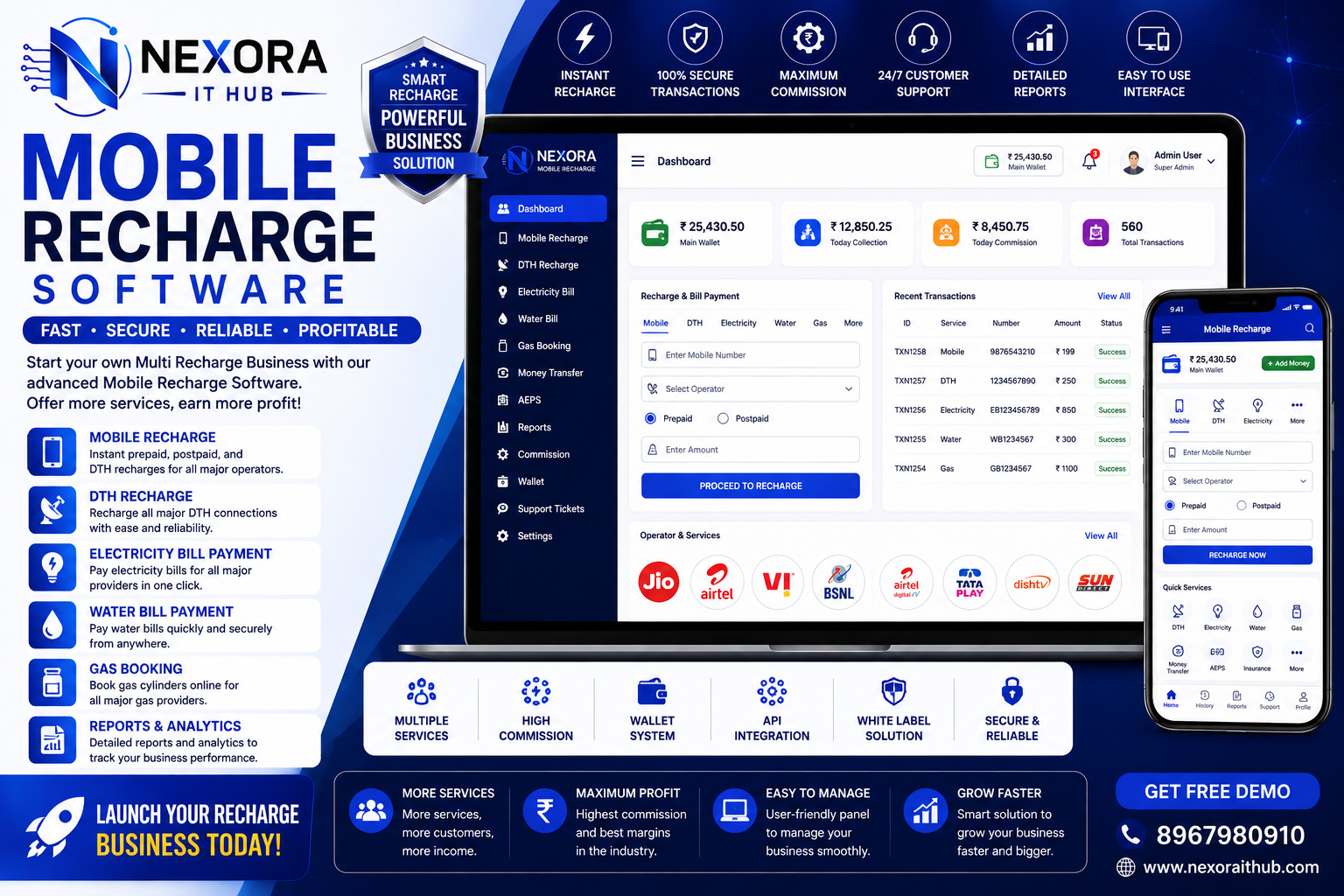
Mobile Recharge Software
Mobile Recharge Software
Mobile Recharge Software is a digital platform designed to help businesses manage mobile recharge, DTH recharge, bill payments, retailers, distributors, agents, wallets, transactions, commissions, and reports through a centralized system.
For recharge businesses, managing multiple retailers, transactions, operators, commissions, wallets, and customer requests manually can become difficult as the business grows. A professional recharge management platform can automate routine operations, improve transaction tracking, and provide administrators with better control over their recharge network.
Nexora IT Hub Mobile Recharge Software can be customized for businesses that want to operate a digital recharge platform with Admin, Distributor, Retailer, Agent, and Customer management capabilities.
The exact recharge services, APIs, payment methods, commissions, and transaction workflows can be configured according to the business requirements and applicable telecom, payment, KYC, consumer-protection, and other regulations.
What is Mobile Recharge Software?
Mobile Recharge Software is a web-based or mobile-enabled platform that allows authorized users to process and manage recharge transactions from a centralized system.
A complete recharge platform can include:
- Mobile Recharge
- DTH Recharge
- Electricity Bill Payment
- Broadband Bill Payment
- Water Bill Payment
- Gas Bill Payment
- Insurance Premium Payment
- FASTag Recharge
- Wallet Management
- Retailer Management
- Distributor Management
- Agent Management
- Commission Management
- Transaction Management
- API Integration
- KYC Management
- Reports & Analytics
- Admin Dashboard
- Retailer Dashboard
- Distributor Dashboard
- Customer Management
- Complaint & Support System
Availability of individual bill-payment services depends on the APIs, providers, and regulatory requirements connected to the platform.
Benefits of Mobile Recharge Software
1. Centralized Recharge Management
A professional recharge platform allows administrators to manage recharge operations from one centralized dashboard.
Administrators can monitor:
- Recharge transactions
- Retailers
- Distributors
- Agents
- Wallet balances
- Commissions
- Failed transactions
- Successful transactions
- Refunds
- Reports
This can make daily recharge operations more organized.
2. Faster Recharge Processing
An API-connected recharge platform can process eligible transactions quickly.
A typical workflow can be:
Enter Mobile Number → Select Operator → Enter Amount → Confirm → API Processing → Transaction Result
The actual processing time depends on the connected service provider or recharge API.
3. Automated Transaction Management
Every recharge request can receive a unique transaction reference.
The system can record:
- Transaction ID
- Mobile number
- Operator
- Amount
- User
- Date & time
- Transaction status
- API response
- Commission
- Refund status
This creates an organized transaction history.
4. Retailer Network Management
Recharge businesses can create and manage retailer accounts.
Administrators can monitor:
- Retailer registrations
- Retailer wallet
- Recharge activity
- Commission
- Transaction history
- Account status
- KYC status
This is useful for businesses operating through a retailer or agent network.
5. Distributor Management
Distributors can manage their assigned retailers and recharge operations through a dedicated dashboard.
Depending on the business model, distributors can view:
- Retailer accounts
- Retailer transactions
- Wallet balances
- Commission information
- Recharge reports
- Performance information
Access can be controlled through role-based permissions.
6. Digital Wallet Management
A wallet system can be used to maintain transaction balances for authorized users.
Wallet records can include:
- Opening balance
- Recharge debit
- Commission credit
- Fund addition
- Refund
- Adjustment
- Closing balance
All wallet transactions should maintain clear ledger records.
Mobile Recharge Software Features
1. Admin Dashboard
The admin dashboard provides centralized control over the platform.
It can display:
- Total Users
- Active Retailers
- Distributors
- Today's Recharge
- Successful Transactions
- Failed Transactions
- Pending Transactions
- Total Commission
- Wallet Summary
- Recent Transactions
Dashboard widgets can be customized according to the business model.
2. Mobile Recharge
The core module allows authorized users to process mobile recharge transactions through integrated recharge APIs.
Possible information includes:
- Mobile number
- Operator
- Circle/region where applicable
- Recharge amount
- Plan
- Transaction ID
- Status
The supported operators and recharge plans depend on the connected API provider.
3. Prepaid Recharge
For supported prepaid services, users can select:
- Mobile number
- Operator
- Recharge plan
- Amount
After confirmation, the transaction is submitted through the configured API.
4. DTH Recharge
The platform can also support DTH recharge where an appropriate provider/API is integrated.
Users may enter:
- Customer ID
- DTH operator
- Recharge amount
The system can record the transaction and response.
5. Bill Payment
Depending on the connected bill-payment provider, the platform can support services such as:
- Electricity
- Water
- Gas
- Broadband
- Landline
- Insurance
- FASTag
Available services depend on provider integration and applicable regulations.
6. Recharge API Integration
API integration is an important component of professional recharge software.
A recharge API can connect the platform with an external service provider.
The API workflow may include:
Recharge Request → API Submission → Provider Processing → Status Response → Transaction Update
The software can handle supported API responses such as:
- Success
- Failed
- Pending
- Refund
- Unknown / Callback Pending
The exact response statuses depend on the API provider.
7. API Callback Management
A reliable recharge platform can use API callbacks or webhooks to receive transaction status updates.
This can help synchronize the final status between the recharge provider and the software.
Callback handling can include:
- Transaction ID verification
- Status update
- Amount verification
- User balance update
- Refund processing
- Transaction log
Proper validation should be implemented to prevent unauthorized or incorrect callbacks.
8. Transaction Management
The transaction module provides a complete record of recharge activities.
Administrators can search transactions using:
- Transaction ID
- Mobile number
- User
- Operator
- Amount
- Date
- Status
This can make transaction investigation easier.
9. Transaction Status Management
Recharge transactions can have statuses such as:
Success
Recharge successfully processed.
Failed
Recharge was not completed.
Pending
Final confirmation is not yet available.
Refunded
The amount has been returned according to the configured refund process.
Status handling should follow the response received from the connected provider.
10. Automatic Refund Management
If a transaction fails after the user's balance has been deducted, the system can support a configured refund workflow.
Example:
Wallet Debit → Recharge API → Failed → Refund → Wallet Credit
Refund rules should be based on the provider's confirmed transaction status.
11. Wallet Management
Each authorized retailer, distributor, or agent can have an individual wallet.
Wallet functionality can include:
- Current balance
- Credit
- Debit
- Recharge deductions
- Commission credits
- Refunds
- Adjustments
- Transaction ledger
12. Fund Request Management
Retailers or distributors can submit fund requests to the administrator.
The workflow can be:
Fund Request → Admin Review → Approval → Wallet Credit
Administrators can maintain records of:
- Requested amount
- Payment reference
- Request date
- User
- Approval status
- Remarks
13. Commission Management
The platform can calculate configured commissions for eligible transactions.
Commission rules may be based on:
- User role
- Operator
- Recharge type
- Transaction amount
- Business agreement
Commission information can be displayed in the appropriate user dashboard.
14. Retailer Commission
Retailers can view their eligible commission information.
The dashboard may show:
- Transaction amount
- Commission
- Net transaction value
- Date
- Transaction ID
- Commission status
15. Distributor Commission
Distributors can receive configured commissions based on the business structure.
The system can generate distributor commission reports according to the configured rules.
16. User Role Management
A professional recharge platform can support different user roles.
Super Admin
Complete platform management.
Admin
Operational and management access.
Distributor
Distributor-level management.
Retailer
Recharge and transaction access.
Agent
Assigned service access.
Customer
Recharge and supported bill-payment services.
Each role can have separate permissions.
17. KYC Management
Where required, the platform can include KYC functionality.
Users may submit:
- Identity information
- Address information
- Required documents
- Business details
Administrators can manage:
- Pending KYC
- Approved KYC
- Rejected KYC
Sensitive identity information should be protected with appropriate access controls and security practices.
18. User Registration
New retailers, distributors, agents, or customers can register through configured registration forms.
Registration fields can include:
- Name
- Mobile number
- Address
- Username
- Password
- Sponsor/distributor information where applicable
- KYC information
Registration workflows can be customized.
19. Operator Management
Administrators can manage supported recharge operators.
Operator records can include:
- Operator name
- Service type
- API configuration
- Status
- Commission configuration
Operator availability depends on the integrated recharge provider.
20. Recharge Plan Management
For providers that expose plan information through an API, the platform can display available plans.
Plans can be organized by:
- Operator
- Region/circle
- Validity
- Amount
- Data
- Benefits
Plan information should preferably be synchronized with the provider rather than maintained manually when real-time accuracy is required.
21. Customer Management
The platform can maintain customer records where appropriate.
Customer information may include:
- Name
- Mobile number
- Recharge history
- Transaction history
Customer data should be handled according to applicable privacy requirements.
22. Recharge History
Users can view previous recharge transactions.
History can include:
- Mobile number
- Operator
- Amount
- Date
- Transaction ID
- Status
- Commission
- Refund status
23. Recharge Receipt
After a successful transaction, the system can generate a digital recharge receipt.
The receipt can include:
- Transaction ID
- Mobile number
- Operator
- Amount
- Date & time
- Status
- User information
Receipts can be displayed, downloaded, or shared according to the platform's functionality.
24. Notifications
The system can provide notifications for important events.
Examples include:
- Successful recharge
- Failed recharge
- Refund
- Wallet credit
- Wallet debit
- Fund approval
- KYC update
- Password reset
SMS, email, WhatsApp, or push notifications can be integrated where supported.
25. Support & Complaint Management
A support module can allow users to raise transaction-related complaints.
Users can submit:
- Transaction ID
- Mobile number
- Complaint category
- Description
- Attachment where required
Administrators can respond and update ticket status.
Reports & Analytics
26. Recharge Reports
Administrators can generate:
- Daily recharge report
- Monthly recharge report
- Operator-wise report
- User-wise report
- Retailer-wise report
- Distributor-wise report
- Success report
- Failed transaction report
- Pending report
27. Wallet Reports
Wallet reports can show:
- Fund additions
- Recharge deductions
- Commission credits
- Refunds
- Adjustments
- Current balance
28. Commission Reports
The system can provide:
- Retailer commission
- Distributor commission
- Operator-wise commission
- Date-wise commission
- Commission status
29. Transaction Analytics
The admin dashboard can display useful metrics such as:
- Total transactions
- Successful transactions
- Failed transactions
- Pending transactions
- Total recharge value
- Average transaction value
- Operator performance
These analytics can help management monitor the platform.
Advanced Mobile Recharge Software Features
Multi-Level User Management
Businesses can create hierarchical structures such as:
Admin → Distributor → Retailer → Customer
The exact hierarchy can be customized according to the business model.
Multi-API Support
A platform can be designed to connect with more than one service provider where technically appropriate.
This can provide additional service redundancy or coverage, subject to provider agreements.
API Priority & Failover
Where multiple providers are legitimately available, the system can support configured routing rules.
For example:
Primary API → Failure / Unavailable → Secondary Provider
Any automated fallback should carefully validate transaction status to avoid duplicate processing.
Mobile Application
A dedicated mobile application can provide recharge functionality for:
- Retailers
- Distributors
- Agents
- Customers
Possible mobile features include:
- Login
- Mobile Recharge
- DTH Recharge
- Bill Payment
- Wallet
- Transaction History
- Commission
- Support
Responsive Web Panel
A responsive web application can work across:
- Desktop
- Laptop
- Tablet
- Smartphone
This allows authorized users to access their dashboard from different devices.
Security Features
Recharge platforms handle financial and personal information, so security is extremely important.
Possible security measures include:
- Secure authentication
- Role-based access
- Password hashing
- HTTPS
- API authentication
- Transaction verification
- Wallet ledger controls
- Admin approval workflows
- Activity logs
- Database security
- Backup management
- Session management
- Rate limiting
- Fraud monitoring
Payment and financial services should use appropriate regulated providers and comply with applicable laws and security standards.
Why Choose Nexora IT Hub?
Customized Recharge Software
Nexora IT Hub can develop a recharge management platform based on your operational requirements.
Professional Admin Panel
Manage users, transactions, wallets, commissions, APIs, reports, and settings from one centralized dashboard.
Retailer & Distributor Panels
Provide separate dashboards with role-specific access.
API Integration
Integrate supported recharge and bill-payment APIs according to provider documentation and agreements.
Scalable Architecture
The software can be designed to accommodate increasing users and transaction volumes.
Mobile-Friendly Platform
Responsive dashboards and dedicated mobile applications can be developed.
Technical Support
Ongoing maintenance and technical support can help keep the platform operational and updated.
Mobile Recharge Software for Different Businesses
A customized platform can be developed for:
- Mobile Recharge Businesses
- DTH Recharge Businesses
- Recharge Retailer Networks
- Distributor Networks
- Digital Service Centers
- Authorized Recharge Agents
- Bill Payment Service Providers
- Retail Shops
- Franchise Networks
The availability of specific services depends on the business's authorization, provider integrations, and applicable regulations.
Mobile Recharge Software Workflow
A typical transaction workflow can be:
User Login
↓
Enter Mobile Number
↓
Select Operator
↓
Select Recharge Plan / Amount
↓
Confirm Transaction
↓
Wallet / Payment Verification
↓
Recharge API Request
↓
Provider Response
↓
Success / Pending / Failed
↓
Wallet & Transaction Update
↓
Receipt / Notification
This workflow can be customized according to the integrated recharge API.
Key Benefits of Mobile Recharge Software
A professional recharge management platform can help businesses:
- Process recharge transactions
- Manage retailers
- Manage distributors
- Manage agents
- Track wallets
- Automate eligible commissions
- Monitor transactions
- Manage refunds
- Integrate recharge APIs
- Generate receipts
- Manage KYC
- Provide transaction reports
- Monitor business performance
- Provide customer support
- Scale recharge operations
Frequently Asked Questions
What is Mobile Recharge Software?
Mobile Recharge Software is a digital platform for managing mobile recharge, DTH recharge, bill payments, users, wallets, commissions, transactions, and reports.
Can the software support multiple operators?
Yes, multiple supported operators can be integrated through appropriate recharge APIs.
Can DTH recharge be included?
Yes. DTH recharge can be added when supported by the selected API provider.
Can electricity bill payment be added?
Yes, electricity and other bill-payment services can be integrated when supported by the appropriate provider and legally available to the business.
Can retailers have separate dashboards?
Yes. Retailers can receive individual dashboards with recharge, wallet, transaction, commission, and support features.
Can distributors manage retailers?
Yes. A distributor hierarchy can be developed with appropriate permissions and reporting.
Can the software manage wallets?
Yes. Individual wallet ledgers can track credits, debits, commissions, refunds, and adjustments.
Can commission be automated?
Configured commission calculations can be automated based on eligible transactions and predefined business rules.
Can a mobile app be developed?
Yes. Android and iOS applications can be developed and connected with the recharge software backend.
Can recharge transactions be tracked?
Yes. Each transaction can have a unique reference and status history for tracking and reporting.
Build Your Mobile Recharge Platform with Nexora IT Hub
As recharge businesses grow, managing transactions, retailers, distributors, wallets, commissions, APIs, refunds, and reports manually can become increasingly difficult.
A professional Mobile Recharge Software solution can centralize these operations and provide administrators, distributors, retailers, agents, and customers with organized digital dashboards.
With features such as Mobile Recharge, DTH Recharge, Bill Payment, API Integration, Wallet Management, Retailer Management, Distributor Management, Commission Management, KYC, Transaction Tracking, Refund Management, Notifications, Support Tickets, Reports, and Mobile App Support, businesses can create a scalable recharge management platform.
Nexora IT Hub can develop customized recharge software based on your business requirements, selected API providers, authorized services, and applicable regulatory requirements.
Build Your Recharge Software with Nexora IT Hub
Professional. Customized. Scalable. Secure.
Nexora IT Hub
📞 8967980910
🌐 www.nexoraithub.com